Decisive · Grunge & Alternative
Rage Against the Machine
Los Angeles four-piece formed in 1991. Combined rap cadence with hard-rock and funk riffs; the 1992 debut put political slogan lyrics on mainstream rock radio and MTV.

Landmark
Killing in the Name · 1992
Build-to-shout structure; early protest-rock citation on US radio.
Opened
Rap-metal without a DJ; political lyric as the default subject.
01 / 06
Rap cadence over hard-rock riffs
The 1992 debut fixes a four-piece writing method: de la Rocha shouts in meter, Morello uses whammy and kill switch as lead voice, Commerford’s funk bass fills the low end. Killing in the Name and Bulls on Parade put protest lyric on MTV without hip-hop backing tracks.
02 / 06
Stable four since 1991
de la Rocha, Morello, Commerford, and Wilk are the only lineup the catalog cites. Vocal absences (2000–2007) split the timeline; Audioslave is Morello, Commerford, and Wilk with Chris Cornell—a parallel project. Peak citation remains the original four on the 1992–99 album run.
03 / 06
Before nu-metal polish
Linkin Park later used verse-rap / chorus-sing splits with DJ beds and pop hooks. Tool shared political-metal festival audiences with RATM in the 1990s. Morello’s effect-chain solos are widely copied; later bands often take the guitar method more than the slogans. Audioslave is the shared project with Soundgarden’s singer. The 2010 free London show answers the 2009 UK Christmas #1.
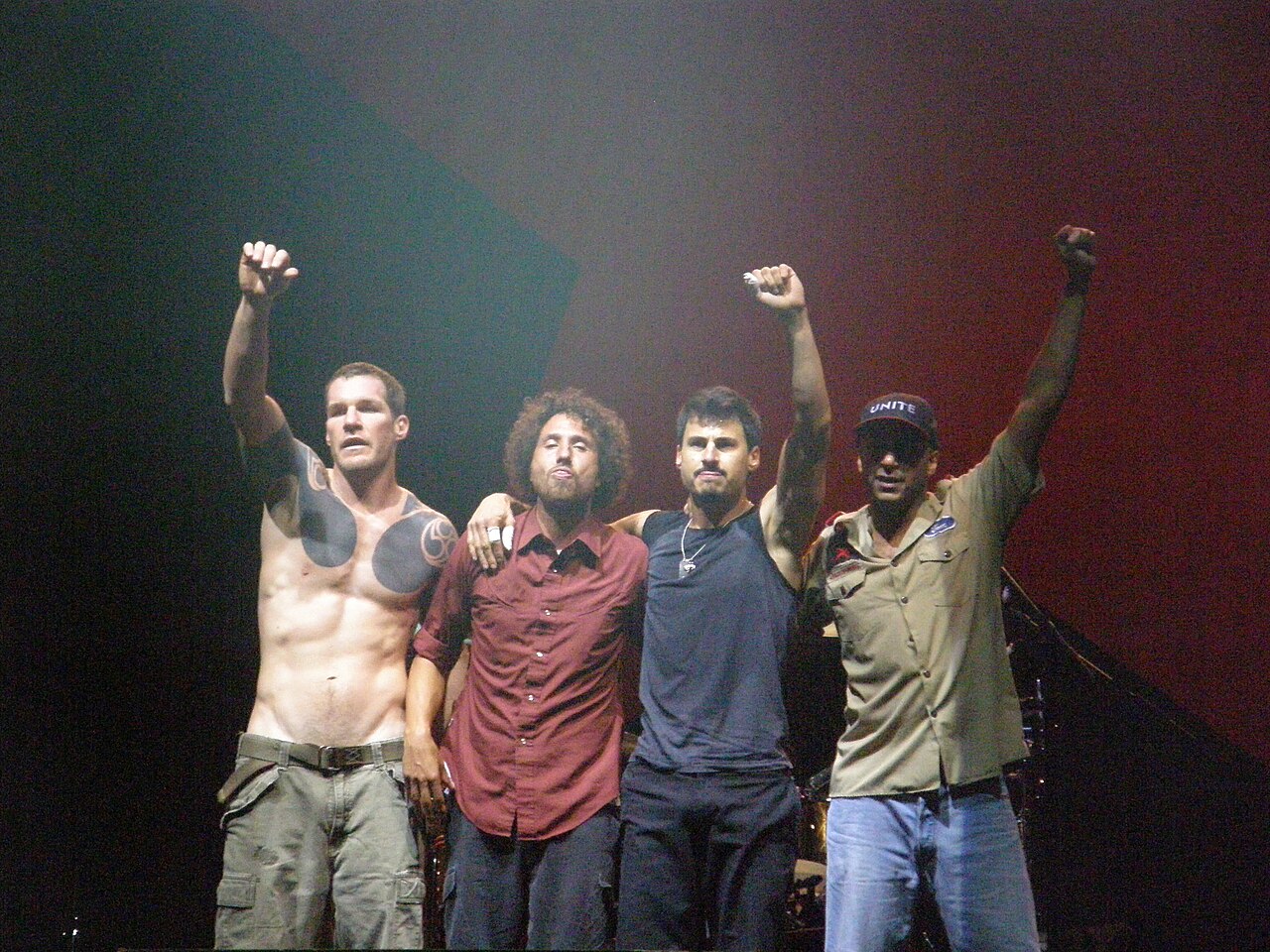
04 / 06
Killing in the Name
Dry funk riff and shouted refrain; no samples, full-band arrangement.
05 / 06
Bulls on Parade
Morello wah as lead voice; Commerford octave bass on the Evil Empire cycle.
06 / 06
Guerrilla Radio
From The Battle of Los Angeles; tight verse-chorus, no nu-metal gloss.
01 / 06
Rap cadence over hard-rock riffs
Los Angeles four-piece formed in 1991. Combined rap cadence with hard-rock and funk riffs; the 1992 debut put political slogan lyrics on mainstream rock radio and MTV.
Lineup versions
Classic four
Peak1991–2000
Morello FX as lead voice; de la Rocha political vocals. The four do not change in the entry. The gap band is Audioslave: the same instrumental trio plus Cornell.
- Zack de la RochaVocals
- Tom MorelloGuitar
- Tim CommerfordBass
- Brad WilkDrums
Quotes
“The guitar is a DJ. The riff is a breakbeat.”
— Tom Morello, 1992 · Guitar interview excerpt
“Anger is a fuel. Organization is the engine.”
— Zack de la Rocha, 1996 · Press interview excerpt
Scenes
| Year | Track | On stage | Tags |
|---|---|---|---|
| 1992 | Killing in the NameDry funk riff and shouted refrain; no samples, full-band arrangement. | Zack de la Rocha, Tom Morello, Tim Commerford, Brad Wilk | |
| 1996 | Bulls on ParadeMorello wah as lead voice; Commerford octave bass on the Evil Empire cycle. | Zack de la Rocha, Tom Morello, Tim Commerford, Brad Wilk | |
| 1999 | Guerrilla RadioFrom The Battle of Los Angeles; tight verse-chorus, no nu-metal gloss. | Zack de la Rocha, Tom Morello, Tim Commerford, Brad Wilk |